Scott Adcox

Doing More With Less Since 1972

Page 86 of 87

Rhyme Toss – Lesson Idea #13

You can play this with 2 or more people, but the more the better. So get some friends, siblings, or dad involved and have fun!

  1. Sit or stand with players in a circle and have something ready to toss (bean bag, ball, etc.)
  2. Say a word like “cat”, and toss the bag to the next person who has to say a word that rhymes like “hat”, then toss to the next person and so on. Switch to a new word when players run out.
  3. Sample word lists you can use: (ball, wall, tall, hall, mall, call, fall, all); ( blue, shoe, two, new, who, boo, flew, drew, etc.); (pit, bit, hit, fit, lit, mitt, sit, kit), etc.
  • You can make this more challenging for older kids by making the words harder. Sample words: (plate, eight, freight, berate, date, mate, bait, gate, hate, etc.).

Short or Long? – Lesson Idea #12

  1. Choose some short words (one syllable) and long words(multi syllable) that show up in books, poems, or songs that your child is familiar with.
  2. As you read each word, ask your child if it is a short word or long word. Keep track of what they say.
  3. Then write each word and ask them again. Show them the differences between the short ones and long ones. Talk about how the ones that sound longer usually look longer too because they have more sounds to write. Check if they were right on their guesses.
  • This activity helps kids with early concepts of print as well as developing their oral language skills. You’ll be surprised by how good they become at this and how it will help them in the future when working with words!

Spell Anything! – Lesson Idea #11

  1. Write a word on a white board or other erasable surface and have your child read it aloud.
  2. Erase and change the first letter/last letter/middle letter – depending on what letters/sounds you are working with. Ask your child what the new word is.
  3. Repeat and repeat until you have a decent list of new words that you created just by changing certain letters.
  4. Have your child read the whole list – blending if necessary and then repeating them quickly to practice fluency. You can extend this activity by having them make up sentences using some or all of the words.
  5. Sample list:
  • start with the word “cup”
  • change the “p” to a “t” for the word “cut”
  • change the ” u” to an “a” for the word “cat”
  • change the “c” to an “h” for the word “hat
  • change the “h” to an “m” for the word “mat”
  • change the “m” to an “f” for the word “fat”
  • add an “s” to make the word “fast”
  • You can see how you can keep going and going with this. You can make this as easy or as hard as you’d like depending on what your child can do. Have fun with it!

Stretch It – Lesson Idea #10

  1. Tell your child that you are going to say a sentence and that they have to help you stretch it by adding a word to it to make it longer.
  2. Then you add another word and continue to take turns adding words until you have a long sentence (that still makes sense).
  3. For example: You say ” The kitten played.” Then it can become ” The white kitten played”, “The white kitten played outside.”, “The white kitten played outside with a ball.”, “The white kitten and the dog played outside with a ball.”, etc.
  • This game can be adapted for many different ages. You can leave it like it is for younger kids (and keep the sentences shorter) or you can add some requirements to make it harder for older kids. Add things like: “Now you have to add a noun, adjective, pronoun, adverb, etc.” or you can have them write out the sentence when finished. this is a great game for developing vocabulary and practicing extending sentences so that they are more detailed!

ABC Scramble – Lesson Idea #9

  1. When your child is not in the room, lay out some alphabet cards in a long row – make sure they are scrambled up and out of order.
  2. Tell your child that you’re not sure what happened, but there’s something seriously wrong with the alphabet and you need their help fixing the letters.
  3. Have your child try to put the letters in a row correctly. They can sing the alphabet or use an alphabet chart to help them out.
  • The sillier you get with this the better! You can make up different stories about what “happened” to the alphabet.

Missing Letters – Lesson Idea #8

  1. Lay out some alphabet cards in a row from A-Z. Remove a letter (random or your target letter) and be sure to leave the empty space where the letter goes.
  2. Have your child start pointing to and naming (or singing) each letter. When they get to the missing letter, ask “What letter is missing?”
  3. After they guess correctly, you can repeat with different letters.
  • What makes this really fun for them is when you get silly and “play dumb” like you really don’t have a clue. It cracks them up!

Pick Two – Lesson Idea #7

  1. Have a collection of pictures ready – including many that rhyme.
  2. Choose three pictures to show two your child and make sure that two of them rhyme. For example have a picture of a tree, a box, and a bee.
  3. Name each picture together and ask your child to pick the two pictures that rhyme.
  4. Start over and repeat as many times as is fun!
  • You can make this harder by adding more pictures and having them pick 3, 4, an so on. Or you can have them choose the pictures and make you pick two that rhyme!

Sack Sounds – Lesson Idea #6

  1. Get a sack or a bag large enough to hold several items.
  2. Have your child go through the house and fill the sack with several random objects.
  3. Meanwhile or beforehand, lay out some alphabet cards in a long row from A-Z on the floor or table.
  4. When your child’s bag is full, have them sort the objects by placing them under the alphabet letter that matches its beginning sound.
  • You can change this up by assigning a set number of items they must find for each target letter – great for review!

Karla — Reading Doesn’t Come Naturally For Everyone

I have read several accounts of parents whose kids have learned how to read on their own. Some of these children began reading slowly while others took off quickly. As impressive as it may seem, I don’t believe that reading truly came as a natural ability for them. I absolutely believe that these parents feel that their kids learned how to read naturally, however, I don’t think they realize how much of a role they played in their children’s learning. While they may not have explicitly taught their kids to read, they certainly taught them implicitly. What I mean is that everything these parents did for their kids (some from the time they were born) helped to build a foundation that would later translate into them becoming literate. Many of these parents share how they would read books to their kids daily, track words while reading, discuss books, provide books and experiences with literature at home, model reading, take them to the library, and many other wonderful activities that expose children to the world of reading. Just because these parents didn’t sit down and provide their kids with formal lessons on reading doesn’t mean that they didn’t teach them how to read. These parents did amazing things for their children even if they don’t realize it! It is this type of parent that is often found behind a child that has learned how to read “naturally”. These kids are one extreme.

Let me give you an example of the other extreme, because some kids aren’t as lucky. I had the opportunity to work with a little girl that convinced me that reading does not occur naturally for everyone. She was an eleven year old girl that was raised by her illiterate grandmother in a small Central American country. Having never attended school, she came to me knowing nothing academically, and had absolutely no knowledge of the alphabet or numbers. Other than that, she was of average intelligence – she just lacked education. She never had anyone that read to her and had never even seen a book until moving to the US. She didn’t even grasp the concept that writing was a representation of the words we speak – she had no idea what those “black and white scribbles” were. Needless to say, she was a very challenging case.

Now most kids fall somewhere in between these two extremes. They probably have parents who read to them occasionally, are exposed to literature, and are aware of why the ability to read is important. Yet their daily modeling of reading may only include functional reading – such as reading menus, tv guides, signs, or other things that simply get people through the day. They may not have someone who emphasizes the importance of learning new things or who encourages them to read nonfiction just to learn about things that interest them. In my opinion, these kids would probably not be able to learn to read if left to their own devices.

I’ll assume that if you’ve made it this far in this article then you’re someone who enjoys reading for the sake of learning. If your kids are in the room while you read this, you are modeling for them right now. Congratulations! You are already taking steps to ensure that your children learn to read and will later read to learn!

Comprehension

Comprehension is THE ultimate goal of reading! Everything we teach our kids in reading is so that they will end up having comprehension, or an understanding of what they read. We spend so much time learning how to read just to get to the point where we can read to learn. Comprehension = knowledge. But just because comprehension is our ultimate goal doesn’t mean that you need to wait till your kids are older or have “mastered” everything else in reading before you teach it.
Continue reading

Letter Hunt Alphabet Book – Lesson Idea #5

You’ll need some newspaper, magazines, catalogs, coupons (any other print material you don’t mind cutting up) and some art supplies (construction paper, glue, scissors, markers, etc.) This one can be worked on over time – so it may take your child a while to complete the whole book. Part of the book can be created while you’re working on letter recognition and the other part can be completed when you work on letter sounds – so there will be two parts to this activity. Some of you may choose to do both pages at the same time – it’s up to you!

Part 1 – Page 1 for each letter

  1. Have your child hunt for and cut out several (up to 20) versions of the same letter (capital and lower case/big and small fonts) from different print material. You want these to look different so that your child learns to identify specific letters no matter the font or size.
  2. Label one piece of construction paper with the target letter at the top. Then your child can glue these letters onto the paper in any way they like as long as they are readable. Although it looks best when the letters are all mixed up and spaced out to cover the whole page, by all means give them creative freedom.

Part 2 – Page 2 for each letter

  1. Have your child hunt for and cut out pictures that begin with the target sound from the various print materials. Review the pictures your child found and discuss whether they’d be good or not to use for that letter.
  2. Your child can then glue the chosen pictures onto another price of construction paper. You can label each picture with a marker (have him/her dictate the names of the pictures to you or help them out). These picture serve to reinforce letter-sound correspondence and build their vocabulary.
  3. Repeat Part 1 and Part 2 for every letter in the alphabet.
  • You can put the pages together several ways: punching holes and tying it together or using rings, staple it, have it bound at an office supply store, etc. I do recommend that you get the pages laminated if possible. This book will be a great addition to your child’s library and is a lot of fun to make!

Alphabet Cereal Game – Lesson Idea #4

You’ll need some alphabet cereal and a simple grid that has the letters of the alphabet separated into individual boxes.

  1. Give your child the grid and a cup of alphabet cereal.
  2. Have them sort the cereal by putting the cereal letters into the letter box on the grid that matches.
  3. Let your child eat the letters when done!
  • This is an excellent hands-on activity that teaches and reinforces letter recognition. It makes a yummy treat too!

Word Switch – Lesson Idea #3

You’ll need a pocket chart and some word cards (you can make them with sentence strips) for this activity.

  1. Make or use some words cards to make up a few sentences from a book, rhyme, or song that your child is familiar with. Make sure to include capitals and punctuations.
  2. Read the sentences aloud to your child (or together if they can read with you). Then mix up the words in each sentence and read them aloud again.
  3. Your child will most likely start giggling and tell you there’s something wrong. Act surprise and like you don’t know what’s wrong. When they convince you that there’s a problem, ask your child to help you make the sentences right again. They can use the capital letter and the punctuation mark as hints.
  • You can skip the materials if you don’t have them and use a white board instead. Although kids really enjoy holding and manipulating the word cards – especially if they can’t write yet. The purpose here is to show your child that each word has meaning and that they work together to make sentences. If you move one or all of them around, it will affect how the sentence makes sense.

Sentence Switch (Sequencing) – Lesson Idea #2

You’ll need a paragraph from a book, magazine, or article (this works best if you type up the individual sentences of a paragraph and cut them to make sentence strips).

  1. Read the chosen paragraph together aloud or have your child read it to you from the original publication.
  2. Next give your child the mixed up sentences and have them try to put them back into the correct order.
  3. Have them read it aloud to check if it is correct and makes sense.
  • You can make this activity more challenging to meet your child’s need or for older kids. You can do this by not letting your child read the original paragraph before asking them to put the sentences in correct order. Even harder: You can also take an article, cut up the paragraphs, and have your child try to put the paragraphs in order to make the article make sense. Treat this like a puzzle and they’ll love the challenge!

8 Shows That Would Be Better Than Rock of Love

I’ll never be able to forgive myself for watching both seasons of Rock of Love in their entirety. The only thing I can do that would possibly atone for my actions is recommend a few shows to VH1 that may allow me to gain some of my self respect back. In no particular order, here are eight shows that would be more interesting and more entertaining than Rock of Love.

Nikki SixxThe Purity is Right With Nikki Sixx

Contestants shoot heroin with the Motley Crue bassist and try to guess it’s purity. The contestant closest to the actual purity level without going over gets to spin the big wheel, which contains various rehab packages. The grand prize includes detox and a spot on Celebrity Rehab with Dr. Drew. All contestants receive a complimentary double dose at the methadone clinic good for one visit only.

David Lee RothSurvivor DLR

Contestants are stranded on a deserted island with David Lee Roth. Instead of being voted off of the island, contestants remove themselves voluntarily. The contestant who can stand DLR the longest is the winner. The game gets harder as more contestants leave and survivors are forced to spend more and more time with Diamond Dave.

Kid RockThe Ultimate Fighter with Kid Rock

The concept is pretty simple–we follow Kid Rock as he tours the country’s Waffle House’s and nightly challenges drunks in pugilistic competition. A game show? Not really, although I guess you could consider anyone who doesn’t get Kid Rock’s bodily fluids on them a winner.

Ozzy OsbourneWhat’s My Line with Ozzy Osbourne

Unlike the original “What’s My Line”, contestants on this show simply listen to Ozzy and translate. Contestants accrue points based on the number of words in each sentence they are able to correctly identify. The winner gets to avoid ever having to know anything about Ozzy’s annoying offspring for the rest of their lives.
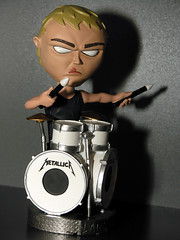
Lars UlrichName Buy That Tune with Lars Ulrich

Lars hosts this new version of the old classic, but with a catch. When a contestant successfully names a tune they are immediately swarmed by lawyers and retired concert security guys with RIAA t-shirts (sleeves rolled up of course). If the contestant is not able to produce proof that they actually purchased the song they’ve just heard, they must choose between being sued by Metallica’s attorneys or having the security guys bludgeon them with those big flashlights (after which you will be sued anyway).

Axl RoseThe Roadie with Axl Rose

This one is sort of like The Apprentice. Each night, Axl Rose will either cancel an appearance, no-show the event, or storm off stage pissed off. Axl will then decide which contestant was responsible for the mishap and fire one. The winner of The Roadie earns the right to be blamed at the next concert for Axl’s behavior, and subsequently fired.

Def LepppardCelebrity Arm Wrestling with The Drummer From Def Leppard

No commentary necessary. On second thought, why did I even post this?

The Biggest Loser

This one is special because it actually pits celebrities people who used to be in bands against one another to see who truly is the biggest loser, literally. It should probably feature the members of bands like Faster Pussycat, Enuff Znuff, Britny Fox, and Vixen

« Older posts Newer posts »

© 2026 Scott Adcox

Theme by Anders NorenUp ↑