“Sounds like 1963. But for now, it sounds like heaven.”
Author: Scott (Page 28 of 80)
I think all of the songs on the Pulp Fiction soundtrack are by the original artists except for “Girl, You’ll Be A Woman Soon”.
Why did they use the Urge Overkill version for this song but originals for the rest?
Glad I got that off my chest.
I’d settle for either being 34 or drinking in a honky tonk.
Now that the hard work is done, it’s time for tapering. That means tending to phantom injuries, freaking out every time I hear one of the kids cough that they are getting the flu and I will catch it too, and checking the weather forecast every 8 minutes.
But it also means filling up the liver and muscles with glycogen and running every mile knowing that I’m only doing it to stay sane, not for fitness.
I haven’t fretted over data/times/pace for this training session like I usually do. Part of that is because I have so much other stuff going on, and part of it is that when training using the FIRST program, it doesn’t really take over your life the way a 6-day-a-week program does. It’s kind of nice.
I did a 23 miler for my last long run yesterday, and I averages 8:59–much faster than I’d planned on running, and a little surprising. I’ve figured out that I need to eat a LOT more than I had been eating (no complaints here), and as a result I have yet to feel the wall this time around.
Anyway, I was going back and comparing this peek week training to the peek week of my best marathon. I’m liking these results:
2003 Peek Week
42 total miles (4 sessions), 6 hours and 35 minutes (9:24/mile average)
2012 Peek Week
40 total miles (3 sessions), 5 hours and 59 minutes (8:59/mile average)
The two big things I notice are that I ran roughly the same miles in both years, but this year I’ve done it in one less session, and at a faster pace. Also, my longest run in 2003 was 20 miles instead of the 23 I did this year.
I’m hoping this means a faster race. 3:49:59 was the original goal. Starting to think 3:44:59 may be a real possibility. It’s all going to be in the execution.
I’ve been running negative splits every day. Do I start with the 3:55 group for the first half and chase down the 3:45 group, or do I just start with 3:45 and try to hang on? That pace sounds tough for me right out of the gate.
I’ve been doing a lot of brainstorming since YamJam…lots of ideas tumbling around in my noggin about how a Yammer network can be energized. Here’s one I came up with and proposed internally that drew the sound of crickets. I still think it’s a good idea, so please tell me why it’s not.
You may have heard of No-Email-Fridays, when people shut down Outlook for the day and refrain from sending or receiving emails. That idea has always intrigued me, but I realized that there are two big problems with it. First of all, it doesn’t really stop you from using Email (The Missus coined the phrase “Stale-Mail”, which I really like), it just changes when you use it. You’ll more than likely set up an auto-response the night before letting anyone who contacts you know what you’re doing, which actually adds messages to the mix, and then spend Saturday or Monday responding to the messages you would have normally responded to on Friday.
What have you actually achieved there?
Secondly, you’re going to annoy everyone who isn’t playing along. The people who get the auto-response explaining what you’re doing will likely think it’s ridiculous, and if you don’t set up the auto-response you are going to be ignoring people. People tend to dislike being ignored.
But what if you entered into mutual “blacklist” agreements with people who understand the need to reduce emails? It’s pretty simple–you simply agree to stop emailing each other. You can call, you can use a tool like Yammer, you can Skype…whatever.
But no emails.
To gamify it, you could implement a rule that anyone who slips up and sends an email has to donate $1 to charity or buy the other person a cup of coffee. The penalty phase of this could get really fun and creative.
I think this would be an easy way to immediately reduce email. So easy in fact, I thought up a wrinkle to make it challenging. What if you were required to recruit one more participant in this program every week or month? It would require some evangelism, but I think it would be worth it.
Shoot holes in this idea for me please.
Lots of good stuff from the morning keynote and customer panel. I think I’m most excited about the announcements of the changes in OpenGraph and pages for the objects created there. Being able to follow and comment on objects created in apps you don’t even have access to is huge.
Funny thing is that I accidentally stumbled into a lot of these features at the end of last weekend when I was doing some tinkering.
Embeddable “Like” and “Follow” buttons are going to be great as well!
Dear gmail: give me a way to act on an email (“Like”, “Thanks”, “Will Do”, etc) by just pushing a button. Let me configure these myself. If the original sender is a gmail/Google apps user, actions can just appear as attributes of original message with a browser notification if that’s what the sender is configured for. If outside, or if the sender wants message notifications to continue, go ahead and send the person an email for me.
But don’t make me type these things out a hundred times a day.
Even better–you could give me the option to white-list individuals to turn their messages into Google+ posts instead of emails from my perspective and I can just +1 them from there.
Thanks!
Scott
Played this in my head on loop for roughly 35 minutes this morning.
You can stand me up at the gates of hell, but I won’t back down.
Tell me doping isn’t happening on a pretty broad basis among age group athletes, and I’ll be more surprised than if you told me it is.
No sour grapes here, mind you. I’m an MOP age-grouper, and I’m only racing myself. So it doesn’t matter to me if age groupers are doping or not. It just seems very likely that it’s happening.
Let’s look at my age group as a ferinstance. If you check out the bikes at a big event, the nicest bikes seem to be in the 40-50 yo age group. It seems like there’s a higher density of high-end bikes there than there is even in the pro group. Based on nothing other than the bikes I see, I’d guess (have no stats on this) that the median income of my age group is well above the median income for triathlon pros, and my observation is that lots of guys in my age group don’t have a problem dropping cash on gadgets and equipment.
In other words, they are more than happy to pay for speed.
In addition, I’d imagine it’s not very tough for a guy in this age group to obtain prescriptions for a wide-range of pharmaceuticals that can help their performance. The question is, how many would actually do it?
Let’s look at a hypothetical situation many of us may be able to relate to. Let’s say an athlete starts off in triathlon in his 30s and works up to the 140.6 distance. Over the next few years he completes multiple iron-distance races, reads a gazillion books, buys a top-of-the-line bike, hires a coach, gets his diet in order, and trains like a madman with hopes of one day qualifying for Kona. We’re talking about years of preparation for a single goal.
He wakes up one day and he’s 39 (turning 40 in the calendar year). He’s moved up an age group, and does a little research to find that he’s on pace to be about 10 minutes away from winning a Kona slot at his A race which is scheduled later in the year. Ten minutes doesn’t sound like much, but then again, 10 minutes is a lot of time to cut off of the time he’s worked so hard to get over so many years. Can you imagine the level of temptation he’d be facing to employ every tactic available to get that 10 minutes and get that Kona slot?
Think very few triathletes would do that just because it’s against the rules?
Remind yourself of that next time a peloton blows by you on the bike during a race.
Now, if all those people in all those pelotons in all those races are willing to let people see them break a rule to go faster on race day, why would they care about breaking a rule in the privacy of their own homes during training to go faster on race day?
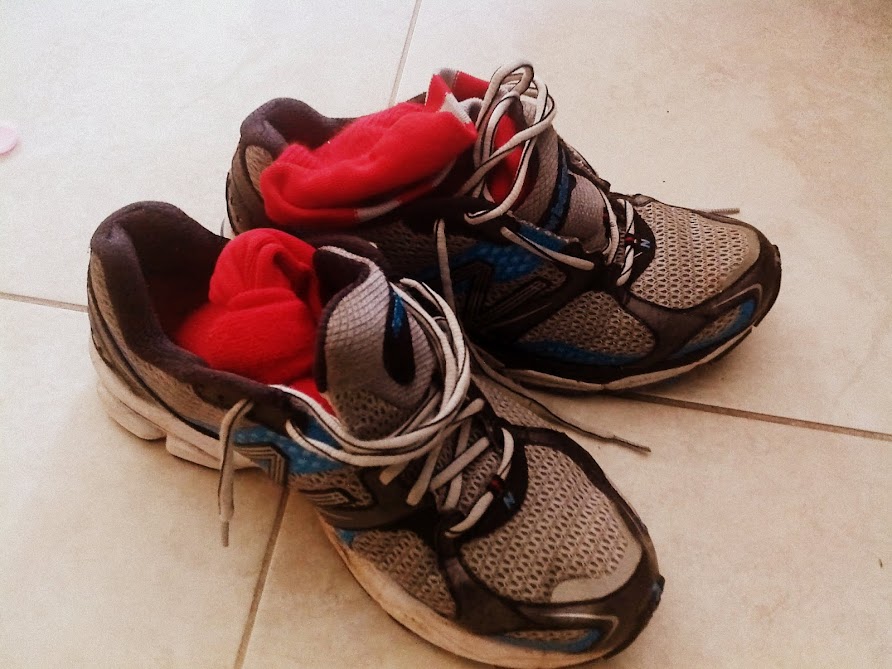
I stink. Seriously, I’m really stinky.
And I sweat a lot. Any run over 8 miles usually results in my feet making squishing sounds with each step. So once I’m deep into a training program, my shoes are in a perpetual cycle:
- Soaked with my stinky sweat
- Set out to dry for a couple of days while I fill a second pair of shoes with my stinky sweat during the next workout
- Rinse and repeat
I usually don’t actually rinse them though. So they build up a dried out, soaked in stinky smell. I try sprinkling them with Gold Bond and baking soda every now and then if I remember, but they usually just end up stinking to high heaven.
The other day I Googled this problem and found a great solution–cat litter.
I filled some old rugby socks with cat litter and stuffed them down into my shoes and left them overnight. This removed about 90% of the smell in the shoes.
I’m very proud to share this little trick with you, and when I find out how to get the cat litter smell out of my shoes I will be sure to post the solution.
You never hear these kinds of allegations against Jazzercise.
Investigators allege Wright ran a prostitution operation out of her Zumba studio in Kennebunk and taped her encounters on video equipment set up by Mark Strong, an insurance agent from Thomaston.
As an insurance agent, Mr. Strong clearly has a firm grasp on the concept of risk management.
Hookers–they aren’t just for rugby any more.
HT PacePerMile
An observation:
People who drive slower than me are idiots. People who drive faster are maniacs.
People who make less than me are lazy. People who make more are greedy.
These two statements are equally true, rational, and reasonable.
I been could do all these tricks. The impressive part is that this guy stayed in Zone 2 for the whole thing.

The end of “running-as-a-punishment” in sports? This is ridiculous on so many levels.
- As a coach, I’ve actually planned on including some punishment running as part of a rugby practice before it has even started. Pretending to be displeased with the performance and effort level of your athletes can help them break through a plateau and push themselves to a place they didn’t realize they could go.
- Group “punishment” can help a team become a more cohesive unit as it creates an “us-against-the-coach” situation. It helps a team build a group mentality weeks before ever facing a real opponent.
- Knowing that punishment running is on the table creates artificial pressure during training. In games, there are built in consequences (it’s called the scoreboard) for lazy play and mental errors. You need to find ways to create that pressure in practice. My college rugby coach never used the word “mistake”. His preferred term was “conditioning opportunities”.
- There’s a huge psychological advantage to be gained at game time knowing that the other team has not outworked you in practice, that the game will be so much easier than your preparation was, and that there’s an expectation of effort (with consequences).
- And then there are the days when your practice plans simply can’t work in enough high work-rate activities to provide your players with the fitness time they need. You don’t want to make them run just for running’s sake, but if you can make it seem like they caused themselves to have to run, you once again raise the expectation level.
We’re getting soft.
HT Remy’s World